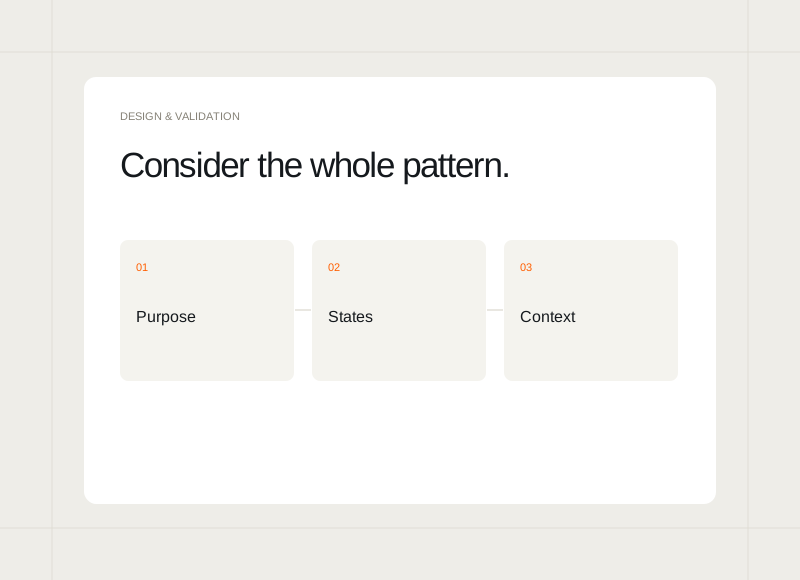
A considered interface is shaped by connected decisions. The words, spacing, actions, and states help someone understand what they can do and what has happened. Visual polish matters, but the experience also needs to remain clear when the task is unfamiliar or something goes wrong.
Give each screen a clear priority
Decide what someone should understand first and what action should follow. Use hierarchy to support that sequence. When every element competes for attention, a person has to work out the structure for themselves. Start with the content and the task, then choose the type, spacing, and emphasis that make the relationship clear.
Let language do useful work
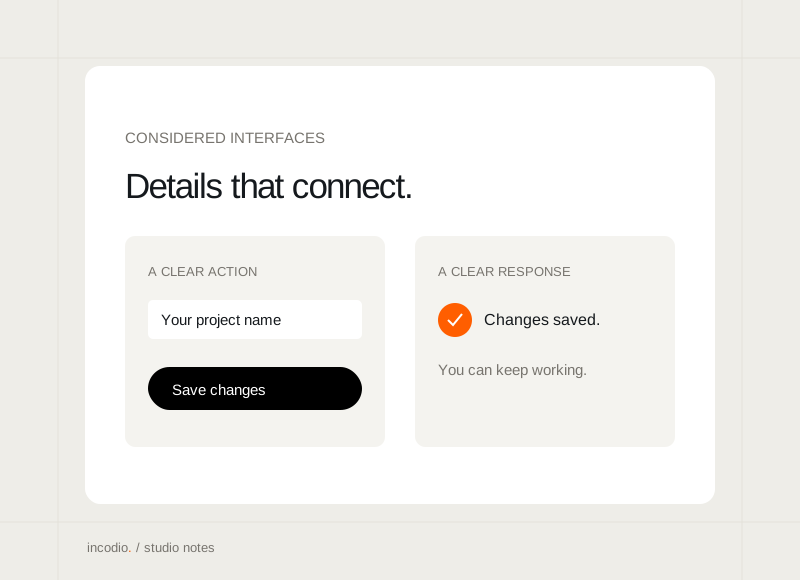
Labels should describe the action or information in familiar terms. A confirmation should explain what happened and what comes next. An error should point to the problem and help someone recover. Treat these messages as part of the interface rather than text to be added after the layout is finished.
Design beyond the ideal state
Consider an empty list, a long name, a missing image, a slow response, and an incomplete form. These states often reveal whether the underlying structure is clear. A helpful empty state can explain the first step. A loading state can confirm that a request is underway without pretending the result is already available.
Make related behaviour consistent
Similar actions should look and behave in a related way. A selected option, a focused control, and a clickable card each need a recognisable signal. Consistency does not require every section to use the same composition. It means a person can carry what they have learned from one part of the product into another.
Review the details in context
Check the experience at different widths and with realistic content. Move through it with a keyboard as well as a pointer. Notice whether a dialog returns you to the right place, whether a label still makes sense, and whether motion helps explain a change. Refine the connections that make the whole journey feel coherent.