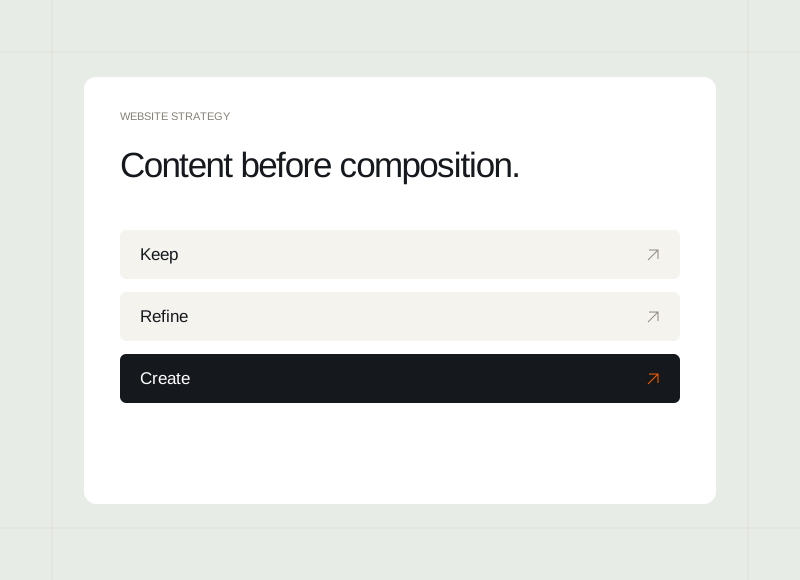
A redesign becomes harder when the content is treated as something that will arrive after the layout. Taking stock early helps the team understand the actual material the website must organise. It also makes missing decisions visible before they become gaps in a polished page.
List the content you already have
Gather existing service descriptions, product explanations, photography, and useful documents. Note where each item is used and who is responsible for it. The list does not need to be elaborate; it needs to make the available material and its ownership easy to review.
Check whether it still represents the business
Read the material against the current offer and audience. Some content may be accurate but poorly organised; other content may describe a service that has changed. Separate those situations so the redesign does not spend time polishing information that should first be revised or removed.
Identify the proof you can actually use
Confirm which project images, customer comments, and other evidence are approved for publication. Keep any restrictions attached to the asset. When real proof is not yet available, plan an honest alternative such as a clearly labelled concept or an explanation of the working process.
Give missing pieces a clear owner
For each gap, name the person who can provide or approve the material. Agree when the design needs it and what can be used while it is being prepared. A visible content plan makes the relationship between writing, design, and review easier to manage.